
November 24, 2026
Short answer: When you buy your next home before selling your current one, you don’t have to drain your savings or wait on your sale to cover the move and the repairs. A buy-before-you-sell program like the Knock Bridge Loan™ can roll your down payment, home-prep repairs, a moving allowance, and several months of your current mortgage payment into one short-term loan — repaid when your old home sells. The part most guides skip is how that money actually reaches you, so that’s what this guide walks through.
Why funding the move is the real squeeze
When you buy first, the hard part usually isn’t the new home — it’s the gap. Your down payment is locked up as equity in a home you haven’t sold, and right when you need cash most, three bills land at once: the move, the repairs to get your old home list-ready, and the overlap of carrying two homes before your sale closes. Paying all of that out of pocket is exactly what sends people back to selling first. (For how the whole sequence fits together, see the buy-before-sell timeline.)
A bridge loan solves it by unlocking the equity you already have, so the money for the move and the repairs comes from the home you’re leaving — not from your checking account.
What a bridge loan can actually pay for
The Knock Bridge Loan™ is built to cover the real costs of moving before you sell, not just the down payment. Depending on your equity and approval, it can fund:
Your down payment and closing costs on the new home.
Repairs and home prep needed to get your current home ready to list and sell.
A moving-expense allowance for the move itself.
Several months of the mortgage payment on your departing home, so you’re not paying two mortgages out of your own pocket during the overlap.
Paying off a HELOC or other junior lien on your current home. If you have a second loan against the home you’re selling, it’s paid off from the bridge loan — and because the loan is secured against that departing home, clearing the lien is required for Knock to make it.
In other words, the same loan that gets you into the new house can also carry the move, the fix-ups, and the in-between. For a fuller look at what’s included and the costs, see what the Knock Bridge Loan covers and the bridge loan cost breakdown.
How the money actually reaches you
This is the question most pages don’t answer: once you’re approved, how do the funds get to the movers, the contractor, and your mortgage company? It works differently for each, and knowing the mechanics up front keeps you from fronting money you don’t need to.
Down payment and closing costs are sent straight to the title and escrow company at your new-home closing. You never handle this money — it funds the purchase directly.
Your old mortgage during the overlap is funded for you: up to six months of that payment is disbursed to you up front as part of the loan — earmarked for exactly that — so you keep paying your mortgage company on schedule without it coming out of your own pocket.
Your moving allowance is paid to you, so you can book and pay the movers.
Repair funds come to you, against documentation — not paid directly to your contractor. Here’s the sequence most people get wrong: you scope the work, get your contractor’s invoice, and sign a short repair agreement; the funds are then released to you so you can pay the contractor. Every file includes a home-prep agreement, even if you don’t end up using repair funds.
So if you’re wondering whether a bridge loan can “pay my contractor or mover before my old home sells,” the honest answer is: the funds are released to you to pay them — tied to invoices and a signed agreement — rather than the lender cutting a check to the vendor. Plan around that, and you won’t need to float major costs from savings.
A simple way to budget it
You don’t need a spreadsheet full of estimates to plan this well. You need to know which costs the loan can carry, who each one gets paid to, and which ones to keep a little cash on hand for. Use this as a planning worksheet with your loan officer:
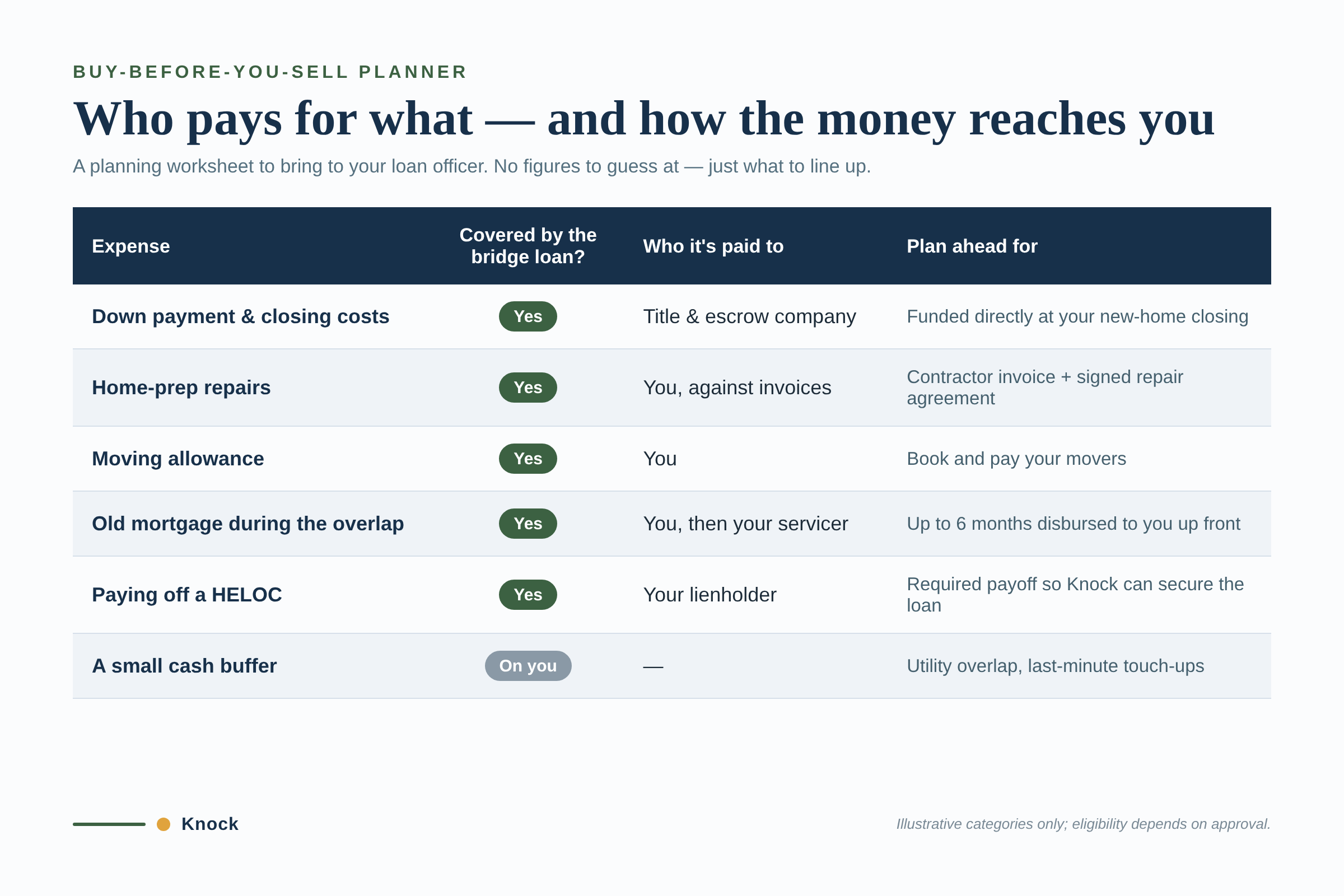
When you talk to your loan officer, come with your list — the repairs you expect, a rough moving plan, and how long you might carry both homes — and the program sizes the advance against the equity in your current home. You don’t have to guess at a number; you describe what you need covered, and the structure is built around it. The cost breakdown is a good companion when you want to understand the fees involved.
What if your old home takes longer to sell?
The advance is a short-term loan with a 0% interest rate and no monthly payments for up to six months — other loan fees apply, and it’s repaid in a single payment when your old home sells or at the end of the term. Most homeowners sell well within that window, but it’s smart to plan for a slower sale:
Keep a modest cash buffer for the odds and ends a program won’t cover — the surprise utility overlap, a last-minute touch-up — so a longer market doesn’t stress your budget. If a slow sale is your worry, what it costs when your old home doesn’t sell is worth reading.
You have a backstop at the end of the window. If your current home hasn’t sold by the end of the six months, a backup Knock Purchase Offer from Knock Property 1, LLC can buy it at a price agreed up front, so you’re never left carrying two homes indefinitely.
That backstop is the reason buying first doesn’t have to feel like a gamble: your move is funded, your old payment is covered during the overlap, and there’s a floor under the sale.
Frequently asked questions
Can a bridge loan pay my movers and contractors before my old home sells? Not directly to the vendor — the funds are released to you to pay them. For repairs, that happens against your contractor’s invoice and a signed repair agreement; your moving allowance is paid to you so you can book the move.
Do I have to pay for repairs out of pocket and get reimbursed later? The repair funds are part of your loan, not your savings. You document the work with an invoice and a signed repair agreement, and the funds are released to you to pay the contractor — so you’re not covering major repairs from your own cash.
Will I be stuck paying two mortgages during the overlap? No. Up to six months of the payment on your departing home is disbursed to you as part of the loan — set aside for that purpose — so you keep paying your mortgage company without it coming out of your own pocket while you wait for your sale to close.
What do I need to show to get funds for repairs or moving? For repairs, a contractor invoice and a signed repair agreement; your loan officer will confirm exactly what’s needed for your file and how the moving allowance is handled.
What happens if my home doesn’t sell within six months? A backup Knock Purchase Offer from Knock Property 1, LLC can purchase your home at a price agreed up front, so you have a reliable exit even if the market is slow. You can read more about options when the old home isn’t selling.
Key takeaways
A bridge loan can fund the down payment, repairs, moving, up to six months of your old mortgage, and the payoff of a HELOC on your current home — not just the purchase.
How the money reaches you varies: the down payment goes to escrow, your moving allowance comes to you, and repair funds are released to you against invoices and a signed agreement, not paid to the contractor directly.
You don’t have to front the move from savings or wait on your sale — the costs come out of the equity you already have, via the Knock Bridge Loan™.
Plan a small cash buffer and lean on the backup Knock Purchase Offer so a slower sale doesn’t derail your budget.
Want to see what your equity could cover before you sell? Get started with Knock.